
Case Report
Cowden Syndrome: A Case Report
Bruna Ewald Montenegro1; Igor Menezes de Faria Pereira1; Adriana Terezinha Neves Novellino Alves1; Luisa Aguirre Buexm1,2
1Medicine School, Faculdade de Medicina de Campos, Campos dos Goytacazes, Brazil.
2Dental School, Universidade Federal Fluminense, Niterói, Brazil.
Received: 26/01/2022; Accepted: 15/02/2022; Published Date: 25/02/2022.
*Corresponding author: Luisa Aguirre Buexm, Department of General Pathology and Pathological Anatomy, Medicine School, Faculdade de Medicina de Campos, Campos dos Goytacazes, Brazil. Email: labuexm@hotmail.com
DOI: 10.55920/IJCIMR.2022.01.001038
Abstract
Cowden Syndrome (CS) is a rare, inherited condition with autosomal dominant characteristics, resulting from mutation in the phosphatase and tensin homolog deleted on chromosome 10 (PTEN) and characterized mainly by multiple hamartomas and increased risk of developing malignancies. The report describes a case in a 43-year-old female patient complaining of a nodule on her cheek. In the anamnesis, a previous history of malignant thyroid neoplasm treated 20 years ago was reported. Physical examination showed multiple small papules on the facial skin around the eyes and mouth, multiple asymptomatic hamartomas on the labial mucosa, jugal mucosa, dorsum of tongue and alveolar ridges. Multiple biopsies were performed in different oral locations, all with histopathological diagnosis of fibrous hyperplasia. The diagnosis of CS was confirmed by the medical history, clinical and histopathological features. The patient is followed up in the medical and dental service.
Keywords: Neoplasms; multiple hamartoma syndrome; genodermatoses.
Introduction
Cowden syndrome (CS) is characterized by the presence of multiple hamartomas in various parts of the body, especially the skin, with mucocutaneous lesions of diverse presentation. The estimated prevalence is one in 1 million in the general population, and it is a very rare condition. There is a preponderance with females, especially Caucasians [8, 9]. Its etiology is genetic with variable autosomal dominant inheritance, associated with a mutation at the 10q22-23 locus. It is related to a mutation in the tumor suppressor gene PTEN/MMAC1, located on chromosome 10q23. In this sense, there is a strong relationship with the development of breast cancer in female patients [8, 11, 13]. Multiple hamartomatous lesions are important clinical markers for identifying patients at risk of developing malignancies, which underscores the importance of early diagnosis [9, 10, 12]. The authors report a case of this rare entity. This is a female patient with a clinical picture characteristic of Cowden’s Syndrome. To describe a clinical case report on Cowden Syndrome, conceptualizing and characterizing it.
Case Presentation
A 43-year-old female patient complaining of a lump on her cheek. In the anamnesis, a previous history of malignant thyroid neoplasm treated 20 years ago was reported (Figure 1A). Physical examination showed multiple small papules on the facial skin around the eyes and mouth, multiple asymptomatic hamartomas on the labial mucosa, jugal mucosa, dorsum of tongue and alveolar ridges (Figures 1B and 1C). Multiple biopsies were performed in different oral locations, all with histopathological diagnosis of fibrous hyperplasia (Figures 2A and 2B). The diagnosis of CS was confirmed by medical history, clinical and histopathological features. The patient is followed up in the medical and dental service.
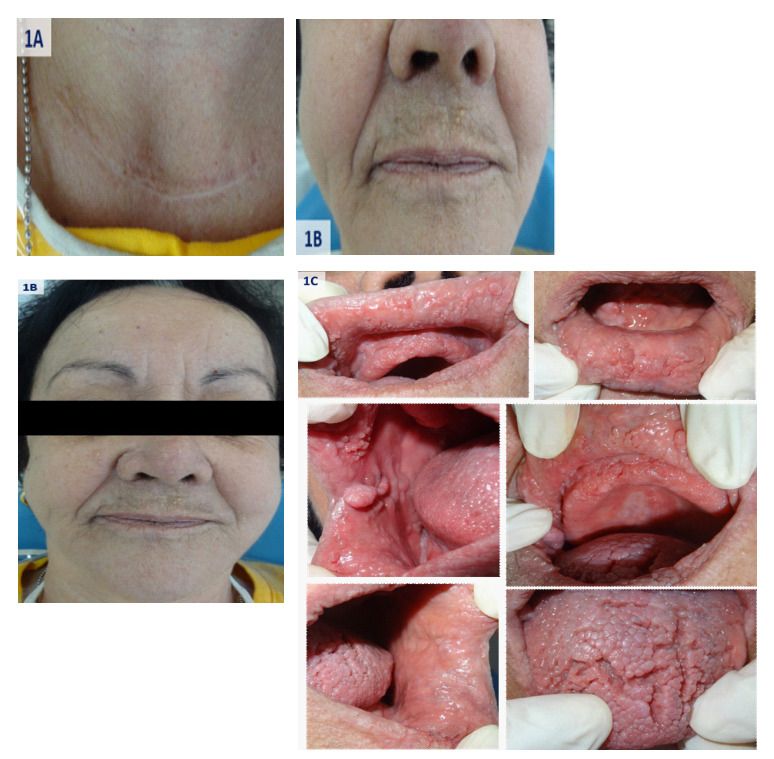
Figure 1: Clinical features: A Thyroid surgery scar; B Multiple small papules around the eyes, mouth and on the facial skin; C Multiple asymptomatic hamartomas, on the alveolar ridges, upper and lower lips, dorsum and lateral border of the tongue, the entire labial and jugal mucosa.
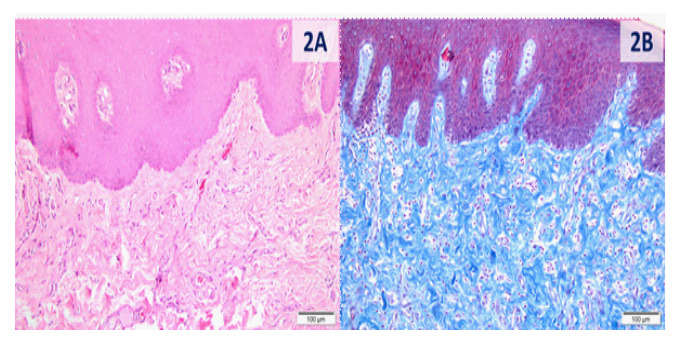
Figure 2: Histopathological characteristics: A Epithelial hyperplasia at the expense of hyperkeratosis and acanthosis. Connective stroma rich in vessels, with mild lymphocytic infiltration, compatible with focal epithelial hyperplasia (Hematoxylin and Eosin); B Epithelium protrudes irregularly through bundles of collagen fibers arranged in different directions, storiform (Masson's Trichrome).
Discussion
Cowden Syndrome is characterized as a rare and severe genetic disorder that affects the skin and other organs and has autosomal dominant penetrance and variable clinical signs and symptoms. However, in the year 2000, the expert body and members of the International Consortium of Diagnostic Criteria for CS (ICC) organized the main features into three categories: Pathognomonic, Major and Minor Criteria [1]. The Pathognomonic Criteria are subdivided into mucocutaneous lesions: facial trichilemmomas, acral keratosis and papillomatous lesions, and adult Lhermitte-Duclos disease. Major Criteria have as a presentation breast cancer; thyroid carcinoma; macrocephaly; endometrial carcinoma. And finally, Minor Criteria can present in the form of other thyroid lesions, oligophrenia, hamartomatous intestinal polyps, fibrous breast disease, lipomas, fibromas, or genitourinary malformations [1, 2, 4]. It is of utmost importance that an adequate diagnosis be made with the presentation of cutaneous findings and existing malignant or benign alterations in other systems and organs, with the mucocutaneous presentation being the most frequent and constant [5]. Moreover, 90% of these patients present some extracutaneous form, and malignant breast and thyroid neoplasms are the most common [6].
Patients with CS should be accompanied by doctors and dentists in the search for mucocutaneous lesions, as well as through blood tests to look for hypo or hyperthyroidism. In addition, it is emphasized the need to look for thyroid nodules and goiters, by means of specific exams. The patient should also be seen by a mastologist and submitted to self-examination and specialized tests. If any involvement in the gastrointestinal tract is identified, the patient should undergo esophagogastroduodenoscopy and colonoscopy for investigation [7]. The patient described in the case presents signs and symptoms that fit the pathognomonic lesion criteria, major and minor criteria. Medical intervention is required for treatment that focuses on improving the aesthetic appearance of the lesions, in addition to active search for associated neoplasms.
Conclusions
Cowden’s Syndrome is a condition that predisposes the development of breast and thyroid malignancies, thus early diagnosis is essential. Thus, healthcare professionals should be able to recognize the characteristic mucocutaneous hamartomatous lesions of CS in order to ensure early diagnosis with screening for internal neoplasms. Therefore, the importance of correct diagnosis and the search for occult malignancies is of utmost importance. The management of these associations may increase the survival of patients with Cowden’s syndrome and improve their quality of life, guaranteeing a good prognosis.
References
- Blumenthal GM, Dennis PA. PTEN hamartoma tumor syndromes. Eur J Hum Genet. 2008; 16(11):1289-300. [ PMID: 18781191; PMCID: PMC6939673 DOI: 10.1038/ejhg.2008.162] [Epub 2008 Sep 10].
- Adam MP, Ardinger HH, Pagon RA, Wallace SE, Bean LJH, Gripp KW, et al. GeneReviews [Internet]. Seattle (WA): University of Washington, Seattle, 1993-2022. [PMID: 20301661].
- Kendall Adkisson, Dirk M Elston, Katherine H Fiala, Craig A Elmets, Richard P Vinson, Lester F Libow. Cowden Disease (Multiple Hamartoma Syndrome) [Internet]. 2022 Jan 26; Available from: http://emedicine.medscape.com/article/1093383overview.
- Gentry WC Jr, Eskritt NR, Gorlin RJ. Multiple hamartoma syndrome (Cowden disease). Arch Dermatol. 1974; 109(4):521-5. [PMID: 4819107].
- Solli P, Rossi G, Carbognani P, Spaggiari L, Gabrielli M, Tincani G, Rusca M. Pulmonary abnormalities in Cowden’s disease. J Cardiovasc Surg (Torino). 1999; 40(5):753-5. [PMID: 10597017].
- Guimarães PDB, Branco ADA, Carvalho E, Lima FE, Almeida JR, Santos JBD, et al. Cowden’s Syndrome: report of a case. An Bras Dermatol. 2002; 77(6):711-720. [Internet]. 2022 Jan 26; Available from:
- Gammon A, Jasperson K, Champine M. Genetic basis of Cowden syndrome and its implications for clinical practice and risk management. Appl Clin Genet. 2016; 9:83-92. [PMID: 27471403; PMCID: PMC4948690 DOI: 10.2147/TACG.S41947].
- Al-Daraji WI, Ramsay HM, Ali RB. Storiform collagenoma as a clue for Cowden disease or PTEN hamartoma tumour syndrome. J Clin Pathol. 2007; 60(7):840-2. [PMID: 17513505; PMCID: PMC1995769
- Ravi Prakash SM, Suma GN, Goel S. Cowden syndrome. Indian J Dent Res. 2010; 21(3):439-42. [PMID: 20930359 DOI: 10.4103/0970-9290.70803].
- The University of Texas, MD Anderson Cancer Center. Cowden Syndrome, Patient Education Office. Revised 10/2020. [Internet]. 2022 Jan 26; Available from: https://www.mdanderson.org/patient-education/Genetics/Cowden-Syndrome.pdf.
- Schweitzer S, Hogge JP, Grimes M, Bear HD, de Paredes ES. Cowden disease: a cutaneous marker for increased risk of breast cancer. AJR Am J Roentgenol. 1999; 172(2):349-51. [PMID: 9930780
- Celebi JT, Tsou HC, Chen FF, Zhang H, Ping XL, Lebwohl MG, et al. Phenotypic findings of Cowden syndrome and Bannayan-Zonana syndrome in a family associated with a single germline mutation in PTEN. J Med Genet. 1999; 36(5):360-4. [PMID: 10353779; PMCID: PMC1734369].
